Wind turbines and how they work
Wind is a form of solar energy. Winds are caused by the uneven heating of the atmosphere by the sun, the irregularities of the earth's surface, and rotation of the earth. Wind flow patterns are modified by the earth's terrain, bodies of water, and vegetation. Humans use this wind flow, or motion energy, for many purposes: sailing, flying a kite, and even generating electricity.
The terms wind energy or wind power describe the process by which the wind is used to generate mechanical power or electricity. Wind turbines convert the kinetic energy in the wind into mechanical power. This mechanical power can be used for specific tasks (such as grinding grain or pumping water) or a generator can convert this mechanical power into electricity.
Types of Wind Turbines
Modern wind turbines fall into two basic groups: the horizontal-axis variety, as shown in the photo, and the vertical-axis design, like the eggbeater-style Darrieus model, named after its French inventor.
Horizontal-axis wind turbines typically either have two or three blades. These three-bladed wind turbines are operated "upwind," with the blades facing into the wind.
Sizes of Wind Turbines
Utility-scale turbines range in size from 100
kilowatts to as large as several megawatts.
Larger turbines are grouped together into wind
farms, which provide bulk power to the
electrical grid.
Single small turbines, below 100 kilowatts, are used for homes, telecommunications dishes, or water pumping. Small turbines are sometimes used in connection with diesel generators, batteries, and photovoltaic systems. These systems are called hybrid wind systems and are typically used in remote, off-grid locations, where a connection to the utility grid is not available.
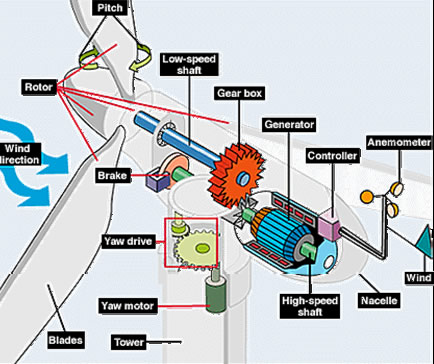
Anemometer:
Measures the wind speed and transmits wind speed data to the controller.
Blades:
Most turbines have either two or three blades. Wind blowing over the blades
causes the blades to "lift" and rotate.
Brake:
A disc brake, which can be applied mechanically, electrically, or hydraulically
to stop the rotor in emergencies.
Controller:
The controller starts up the machine at wind speeds of about 8 to 16 miles per
hour (mph) and shuts off the machine at about 55 mph. Turbines do not
operate at wind speeds above about 55 mph because they might be damaged
by the high winds.
Gear box:
Gears connect the low-speed shaft to the high-speed shaft and increase the
rotational speeds from about 30 to 60 rotations per minute (rpm) to about
1000 to 1800 rpm, the rotational speed required by most generators to
produce electricity. The gear box is a costly (and heavy) part of the wind
turbine and engineers are exploring "direct-drive" generators that operate at
lower rotational speeds and don't need gear boxes.
Generator:
Usually an off-the-shelf induction generator that produces 60-cycle AC
electricity.
High-speed shaft:
Drives the generator.
Low-speed shaft:
The rotor turns the low-speed shaft at about 30 to 60 rotations per minute.
Nacelle:
The nacelle sits atop the tower and contains the gear box, low- and highspeed
shafts, generator, controller, and brake. Some nacelles are large
enough for a helicopter to land on.
Pitch:
Blades are turned, or pitched, out of the wind to control the rotor speed and
keep the rotor from turning in winds that are too high or too low to produce
electricity.
Rotor:
The blades and the hub together are called the rotor.
Tower:
Towers are made from tubular steel (shown here), concrete, or steel lattice.
Because wind speed increases with height, taller towers enable turbines to
capture more energy and generate more electricity.
Wind direction:
This is an "upwind" turbine, so-called because it operates facing into the wind.
Other turbines are designed to run downwind," facing away from the wind.
Wind vane:
Measures wind direction and communicates with the yaw drive to orient the
turbine properly with respect to the wind.
Yaw drive:
Upwind turbines face into the wind; the yaw drive is used to keep the rotor
facing into the wind as the wind direction changes. Downwind turbines don't
require a yaw drive, the wind blows the rotor downwind.
Yaw motor:
Powers the yaw drive.
Related content
Related Photos
- Wind turbine solutions and systems available at Gensets @ Gentag - see them here
Share this content..
Like this? Consider sharing it on any of these social bookmarking websites.


